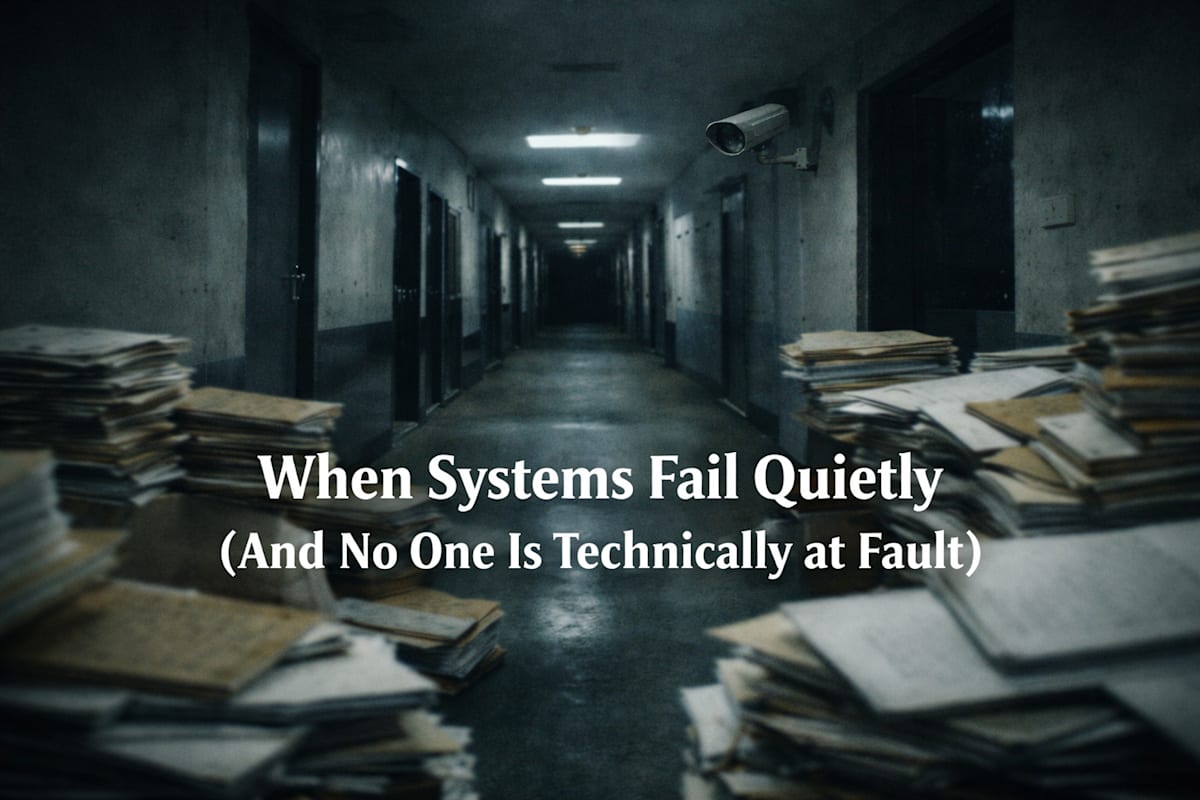
Most failures are not loud.
They don’t announce themselves with alarms or apologies. They don’t arrive as singular, dramatic events. Instead, they settle into place through procedure—through forms completed correctly, meetings minuted accurately, and decisions deferred in ways that feel reasonable at the time.
No one breaks the rules.
No one behaves monstrously.
And yet, harm occurs.
This is the kind of failure that rarely attracts accountability, because it doesn’t resemble what we’ve been taught to recognise as wrongdoing. There is no obvious villain to remove, no corrupted individual to expose. Responsibility disperses across departments, timelines, and interpretations until it becomes functionally invisible.
Each step makes sense in isolation.
Together, they produce something indefensible.
What makes these failures especially durable is how comfortable they feel. They are reinforced by language that softens impact: process, protocol, review, due course. Harm becomes something that happened eventually, rather than something that was allowed.
The system doesn’t collapse.
It continues.
That continuation is often mistaken for stability.
But continuity is not the same as safety. A system can function perfectly while producing unacceptable outcomes, provided those outcomes fall within its definitions. This is why institutional failure is so difficult to interrupt: it rarely looks like malfunction. It looks like professionalism.
By the time consequences become visible, they are often framed as anomalies—tragic, regrettable, but unrelated to structure. Attention turns towards mitigation rather than prevention. Lessons are “learned”. Policies are updated. The core logic remains untouched.
Quiet failure is not an accident.
It is an emergent property.
And because no one person caused it, no one person is required to stop it.
That is the most dangerous feature of all.